NSDR: What Non-Sleep Deep Rest Is and How to Try It
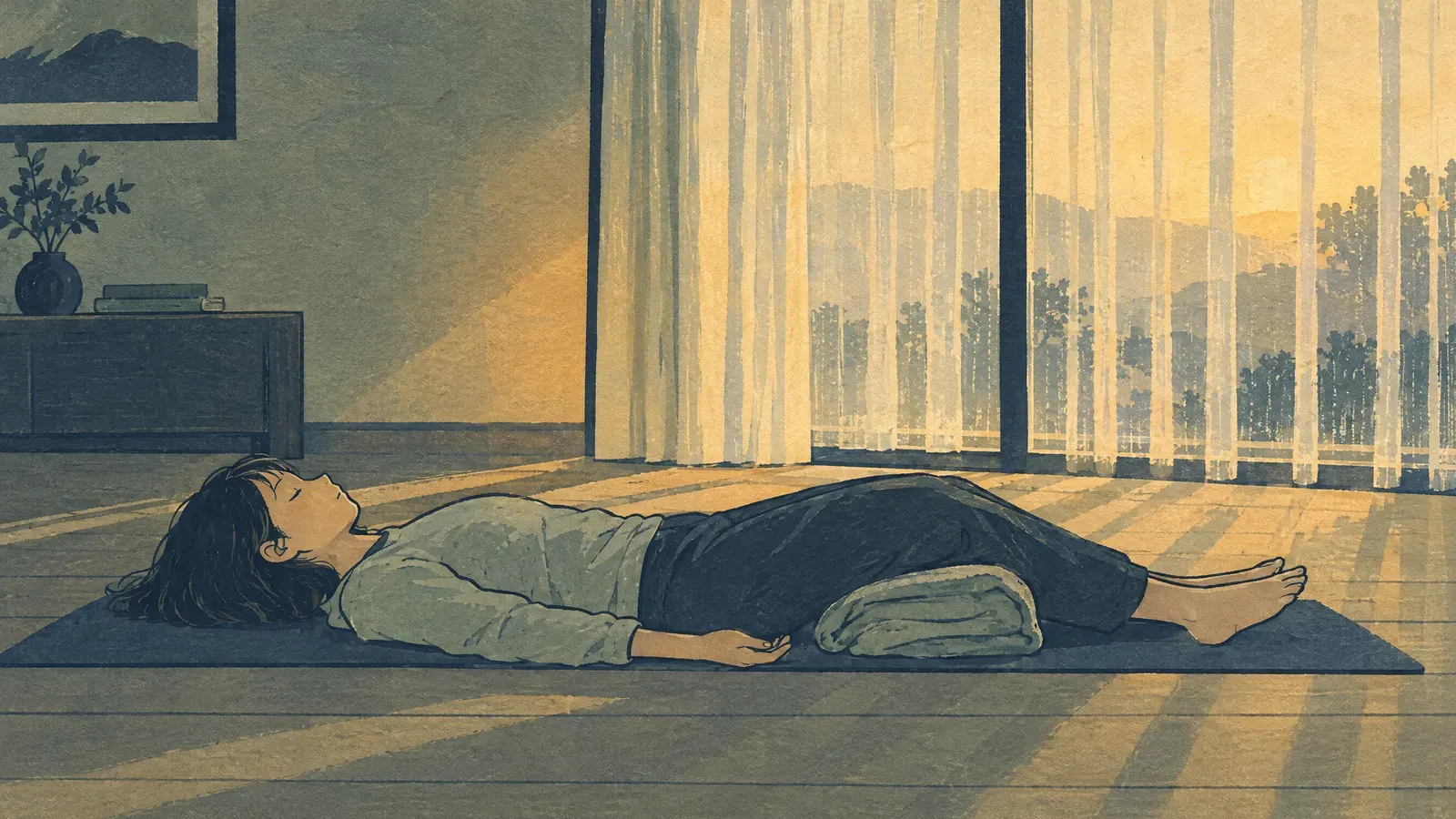
NSDR, or non-sleep deep rest, means lying down for 10 to 30 minutes with your eyes closed and following a voice that walks your attention slowly through your body, while you stay awake the whole time. The podcaster Andrew Huberman popularized the term as a plain label for yoga nidra and similar body scans. People use it before bed and after a bad night, and what they report is a calmer, less restless half hour. It won’t stand in for sleep. We don’t have a guided NSDR recording, so bring your own voice track; if you want a quiet background under it, the gentle rain player runs in a browser tab, free and without an account.
What NSDR means
NSDR stands for non-sleep deep rest. The name describes what happens: you rest deeply, and you stay awake. Huberman’s NSDR page gathers yoga nidra recordings and body-focused guided audio under that one name.
That breadth is worth knowing before you download anything. There’s no standard protocol behind the name, no agreed length and no official script. One track is a plain body scan with nothing else in it, and the next adds music, counting and an intention to set at the start. Evidence collected on yoga nidra doesn’t automatically cover a recording that simply borrowed the letters NSDR.
How to do NSDR tonight
The technique needs ten minutes and somewhere to lie down, and that’s the whole setup.
1. Pick a place where getting sleepy is safe
A bed, a sofa, a mat on the floor. The rule is that nothing bad happens if you drift off, so not behind the wheel, not while a pan is on the stove, not while you’re the one watching a toddler. If lying flat hurts or makes breathing harder, do it propped up or on your side.
2. Choose a length and put the phone out of reach
Ten minutes for a first try. Start the recording, then set the phone face down on a shelf or a nightstand instead of on your chest. Tell anyone else in the room that you’re unavailable for a bit, and turn off the notifications that would otherwise pull you out at minute four.
3. Lie down and let your face and shoulders go slack
Close your eyes if that’s comfortable. Unclench your jaw, let your shoulders drop into the mattress, open your hands. Breathe the way you normally do; you don’t need long slow breaths for this, and forcing them usually makes people tense up. If you want a breathing exercise instead, that’s a different practice with its own instructions.
4. Follow the voice through your body
A guided session moves your attention in order: feet, legs, hips, belly, hands, arms, neck, face. At each stop you just notice what’s there, like the weight of a heel on the mattress or warmth in your palms. Nothing has to feel special. When you notice you’ve wandered off into tomorrow’s meeting, go back to whichever body part the voice is on. That’s the practice, and the wandering is not a mistake.
5. Come back slowly
At the end, let the room come back before you move. Wiggle your fingers and toes, roll onto one side, sit up, and give yourself a minute before anything that needs your full attention. At bedtime you skip this part and stay where you are.
Does NSDR work?
Less is known about it than the confident name suggests.
Research on NSDR under that name is thin. It’s a label from a podcast, not a clinical protocol, so studies mostly don’t use the word. People quote work on the older practice it borrows from instead.
Yoga nidra has real, if small, research behind it. A 2023 review pulled the studies together and found people had looked at sleep along with other outcomes, but the recordings and the methods differed enough that they don’t add up to one clear answer (Pandi-Perumal and colleagues, 2023). Researchers are now looking at sleep directly: a systematic review of yoga nidra trials for poor sleep and insomnia ran through March 2025 (PubMed record). That’s a field starting to take the practice seriously, not a result you can lean on tonight.
So the fair claim is small and still useful. A guided session gives a restless mind a sequence to follow and a clear end, it costs you nothing, and a week of it tells you if you like it. Claims about hormones, dopamine or recovered performance from a ten-minute recording go well past what anyone has shown.
Can you do NSDR before bed?
This is the easiest time to use it, because drifting off is welcome rather than inconvenient. Get into bed first, lights off, then start the session; if you wait to feel sleepy before setting things up, you end up back on a bright screen.
Two practical things. Pick a recording you already know, so you’re not scrolling through a list at midnight. And skip to the last minute of a new track before you trust it at bedtime, because plenty of them finish with music swelling or an advert, and that will pull you straight back out.
If you wake at three and can’t drop off again, the same session gives you something to do besides checking the clock and counting the hours you have left. Keep the screen dark and don’t restart it four times.
NSDR, a nap, yoga nidra and meditation
People ask if NSDR is only meditation under a new name, or a nap with better branding. It overlaps with both, and the differences matter mainly for what you should expect from it.
| Practice | What you do | What sets it apart |
|---|---|---|
| NSDR | Lie still and awake, following a voice through your body | A catch-all name rather than one fixed method |
| Yoga nidra | The same kind of guided rest, in a set sequence from the yoga tradition | The older practice, and the one with studies behind it |
| Meditation | Sit or lie down and train attention on breath, sound or thought | Attention practice is the point; rest comes as a side effect |
| Nap | Actually sleep | Real sleep, with real grogginess to walk off afterwards |
A nap and a session of rest aren’t interchangeable. If you’re short on sleep and you have a safe half hour to lie down, take the nap.
Where sound fits
A voice guide gives you the instructions, and a steady background gives the voice somewhere quiet to sit. Keep those two jobs separate. People who look for one recording that does everything usually end up with music that keeps pulling their attention around.
Put something dull and level underneath at a volume well below the voice, so that the fridge switching on or a door in the hallway doesn’t stand out. Gentle rain is our pick for this: mostly a soft, even hiss, which is what softens the sounds around the pitch of voices and above. A deep rumble like traffic or a boiler goes straight through rain, and brown noise is the sound that covers that. Listen to the two back to back at the volume you’d actually use.
If you want the sound to carry you into sleep afterwards, leave it running when the voice stops. The player has a 15-minute timer, which fits a short session, and Off if you’d rather let it play and stop it yourself. Keep a phone speaker off the pillow, and remember that turning it up is not the way to make it work better.
NSDR and insomnia
People with insomnia do use guided rest, usually as a way to spend a bad hour less unpleasantly, and relaxation techniques turn up inside broader treatment. It isn’t a treatment on its own, and no one should be promising that.
The approach with strong backing is cognitive behavioral therapy for insomnia. NCCIH says clinicians may suggest relaxation in some situations and recommends CBT-I for insomnia (NCCIH sleep guidance). If bad nights have run for months, or your days are suffering, ask a doctor about that rather than adding another recording.
What not to expect
“Deep rest” describes how a session can feel, not a stage your brain entered. Deep sleep is something a sleep lab measures, and lying down with your eyes closed isn’t it. You also don’t have to feel heavy, lose track of time or stay perfectly awake for a session to have counted.
Nothing here fixes being badly short of sleep, so stay off the road and away from anything risky while you’re that tired. And if lying still makes you more anxious, or your back starts complaining, stop and try something else. A recording whose voice irritates you is the wrong recording, so pick a different one.
Frequently asked questions
What does NSDR stand for?
Non-sleep deep rest. It’s a guided rest you do lying down and awake, usually 10 to 30 minutes long, and the name is a plain-English label for yoga nidra and similar body scans. Andrew Huberman put the term into circulation on his podcast.
Is NSDR the same as yoga nidra?
Close, but not identical. Yoga nidra is one practice with a set sequence and a long tradition behind it. NSDR is a wider label that covers yoga nidra along with body scans and other guided relaxation recordings, so two tracks called NSDR can give you quite different instructions.
How long should an NSDR session be?
Nobody has worked out a right length, so pick by what you have. Ten minutes tells you the difference between lying there on your own and following a voice, and most recordings run 10 to 30 minutes. Longer sessions make falling asleep more likely, which is fine in bed and a problem on a work break.
Can NSDR replace sleep?
No. A quiet session can feel better than lying in bed annoyed, and that’s worth something after a bad night, but sleep does things for the body that awake rest doesn’t, and no study shows that NSDR cancels out what missing sleep does to you. If you’re sleepy enough that driving feels risky, it still is.
Can you do NSDR before bed?
Yes, and it’s one of the easier times to try it, because you don’t have to worry about getting drowsy. Start it once you’re already in bed with the lights off. Pick a recording you’ve heard before so you’re not hunting through a screen, and check that it doesn’t end with a loud outro or an advert.
What if I fall asleep during NSDR?
Then you napped, which is a fine outcome in bed at night and an awkward one at two in the afternoon. It does mean the session stopped being non-sleep rest. If afternoon naps are eating into your nights, talk the timing over with a doctor rather than guessing.
Research referenced
- Huberman Lab, Non-Sleep Deep Rest (NSDR).
- Pandi-Perumal and colleagues (2023), Yoga nidra: an integrative review.
- Systematic review of yoga nidra for sleep disturbance and insomnia, trials through March 2025 (PubMed record).
- NCCIH, Sleep disorders and complementary health approaches.
Related guides
- Breathing exercises for sleep
- The Huberman sleep routine, ranked by evidence
- How to fall asleep with ambient sound
- Best sounds for deep sleep
Explore more sounds in Slo
Stack two or three sounds, keep the blend, and let the timer stop it. Slo, on iOS, Android and Mac.