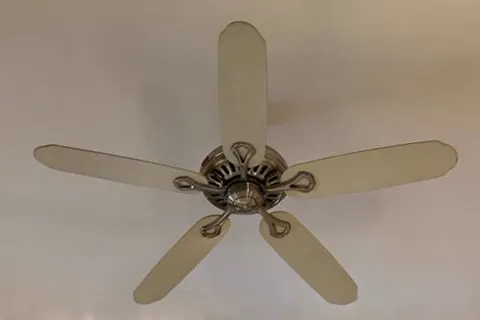



What a fan covers, and what it misses
A fan is a broad whirr with a deep rumble underneath it, so it works on the sounds that arrive from below and outside: the highway, a boiler that fires at two, a bass line from the apartment downstairs. Those stop standing out. It's also why people who sleep with one call it a presence in the room, something the whole bedroom is sitting inside.
Bright, sharp sounds go straight through it. Keys dropped on a counter, a phone buzzing on wood, a door latch, a conversation in the hallway. Voices are the hard case for anything you play, because your ear keeps hunting for words, and a fan blurs them less than white noise does. If that's what wakes you, the white noise preset linked at the bottom of this page is the better place to start.
Why people run a fan in winter
Plenty of people keep a real fan running through the winter for the sound and just put up with being cold. The sound is the part doing the work, and a recording gives you that at any temperature, without a bearing that gets noisier as the years go on.
What a recording can't copy is the particular fan you got used to. If what you grew up with is a box fan on the floor, a ceiling fan overhead will sound wrong to you, and you'll keep noticing the difference all night. The fan page above this one also links to a household fan and a metal table fan; the table fan is the brightest and most mechanical of the three. Try whichever one matches the room you remember.
The brown noise underneath
A fan recording has a slow cycle in it, the blade coming round and the motor loading and easing. Over a whole night that cycle becomes the part you notice, the way you start to notice a dripping faucet. The quiet brown noise sits under it and fills the dips, and it's the one layer here you shouldn't be able to pick out on its own.
If you want to hear what it's doing, drag the brown noise slider down to zero for ten seconds, listen for the wobble, then put it back. On a phone speaker you won't hear much difference, because the phone was never playing that part anyway.
Tonight
- Press play. The ceiling fan opens at 60% and the brown noise at 20%, which is a sensible place to start.
- If all you hear is a thin whirr, you're on a phone speaker. Move to earbuds, or a speaker big enough to play deep sound.
- Set the level while the room is as noisy as it gets, and check your alarm still cuts through it.
- The timer opens on All night, eight hours, the way a real fan would run. Tap 30 min or 60 min for a shorter stretch.
Frequently asked questions
Is fan noise good for sleep?
It helps when noise is what wakes you, and it helps most with the deep end of it: traffic, a boiler, footsteps and bass from the apartment below. Plenty of people also find a steady whirr easier to lie in than a silent room. What it won't do is make you sleepy, and it barely touches voices or anything sharp.
Fan noise or white noise for sleeping?
They cover different halves of the room. A fan is the deeper of the two and does better on a rumble; white noise is a brighter hiss and blurs voices and clatter better. Play both at the same low level for a minute each and keep the one you stop noticing first.
Can I use this instead of running a real fan?
For the sound, yes. For the air, no, so keep the fan if cooling is what you're after. The gain is that you get to keep the noise in winter without the draft, and a recording sounds the same every night.
Why does this sound different from my own fan?
Blade count, motor, mounting height and the room all change it, so no two fans match. This recording is a ceiling fan, wide and overhead. The fan page above this one also has a household fan, which sits in the middle, and a metal table fan, which is the brightest and closest of the three.
Should fan noise run all night, or stop on a timer?
If it's standing in for a fan you used to leave on, run it all night, and the timer arrives set that way for eight hours. A sound that stops at three in the morning is itself a change in the room, and change is what wakes people. Tap 30 min or 60 min if the noise outside only lasts while you're dropping off, or Off to let it play until you stop it.