Free Online Player
Waterfall
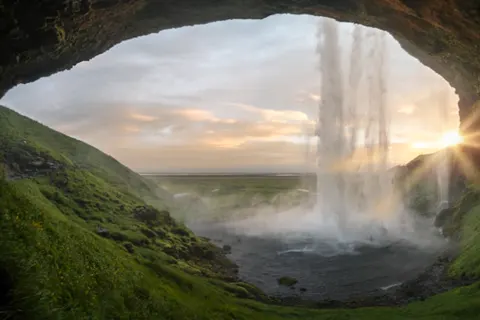
A waterfall combines a powerful continuous cascade with bright spray and countless smaller splashes. Its broad roar can fill a room more firmly than a stream while retaining the motion of real water. Set the uninterrupted cascade far enough back to feel distant, and time it around rest, meditation, or focused work as needed. There's no file to download here: it plays in this browser, and the Slo app keeps a sound on your phone after you play it once.
Ready to play
Put this under rain or a fire, keep the blend you end up with, and play it through the night with your screen off. The Slo app does that on iOS, Android and Mac.


Why falling water sounds so broad
Water accelerates over an edge, breaks into sheets and droplets, entrains air, and strikes the pool or rock below. Large masses contribute a deep, steady roar; spray, bubbles, and collisions add a bright granular edge. Because new water is always arriving, thousands of events overlap without a pause or repeating rhythm. Together they cover almost everything the ear picks up, which is why a big waterfall heard from a distance can sound like brown or white noise while still sounding like a real place.
A river carries water forward through changing channels; a waterfall sends all of it over one edge at once. Heavy rain distributes impacts over a wide area, whereas the cascade has a stable source and sense of depth. It never lets up, which is what makes it good at covering noise, though anyone who wants a quieter scene will find gentle rain easier to live with.
A vigorous background for focus and rest
The broad roar can soften quiet conversation, changes in traffic, or a machine hum, and it adds no words of its own. For study, let the roar become an acoustic horizon rather than a feature you inspect. Lower it if the spray sounds sharp or if you need to raise your own voice. A nature recording can make a workspace feel less enclosed, though it cannot provide actual privacy or soundproofing.
At bedtime, some people like that it never lets up, and others find it too busy, or hear running water and feel wide awake. Use preference as the test. Waterfall audio may help establish a stable setting, but it does not treat sleep problems, anxiety, or tinnitus. Persistent concerns deserve appropriate professional care rather than ever-higher playback.
Move the waterfall farther away
Strong recordings work best at restrained volume. Start with the source across the room and imagine hearing falls from a trail rather than standing underneath them. Wait for your ears to adapt, keep safety signals available, and use 15 or 30 minutes for meditation or a break. Continuous play should remain comfortable over the whole session.
In the sound mixer, add a small amount of forest birds for a vivid daytime landscape or place brown noise underneath when you want a smoother low foundation. Compare its force with the moving detail of river sounds, and see the nature-sounds guide for a measured account of why environmental recordings may feel restorative without guaranteeing an outcome.
Frequently asked questions
Why does a waterfall sound like noise?
Millions of splashes, bubbles, and bursts of spray overlap at once, so what reaches you is one continuous roar with no separate notes in it.
Will a waterfall cover traffic noise?
It can take the edge off light traffic, especially the deeper part of it. It cannot block a loud vehicle, and it is no substitute for insulation.
Is waterfall audio good for meditation?
It can provide a steady attention anchor: notice the roar and fine spray, then return to them when the mind wanders. Keep the level gentle.
Are waterfall and brown noise the same?
No. Brown noise is a machine-made deep rumble that stays the same all the way through. A waterfall can sound just as deep, but it keeps moving, with real splashes and spray and a real sense of place.