Blue Noise and Rain for Reading
Light, high-frequency texture under rain for a clean reading space.
- Blue Noise 50%
- Rain 36%
Brown noise, pink noise and steady rain are the best sounds for reading: no words, no melody, and a low hiss that stays behind the text instead of pulling at it. Slo’s free browser players at slonoise.com cover all three, and the mixer sets rain and noise to separate levels on a timer.
| What you are reading | First choice | Alternative | Avoid first |
|---|---|---|---|
| A novel | Songs you know the words to | ||
| Textbook or dense non-fiction | Podcasts and audiobooks in the background | ||
| Long articles on a screen | A playlist that changes track | ||
| Reading in bed | Thunder and other loud events | ||
| On a train or bus | Turning the volume up to beat the engine | ||
| In a café with clear conversation | in headphones | Café ambience layered on real café talk | |
| Re-reading something familiar | Nothing in particular, this one is forgiving |
Treat these as starting points. A background sound is doing its job when the room stops interrupting you and the sound itself fades out of mind. If you catch yourself listening to it, make it simpler or turn it off.
Reading is continuous language processing. You are holding a sentence open while the next one arrives, and that work uses the same verbal machinery that other people’s speech runs on. Play a podcast, an audiobook or a song with lyrics behind a paragraph and the two streams end up in the same queue. Most readers notice this as re-reading the same line twice without meaning to.
Melody does something quieter but similar. A tune has structure you can anticipate, and anticipation is attention. Your ear leans forward for the chorus and your eye stops moving. Steady, wordless sound has nothing to lean toward. That is the whole trick, and it is why this list looks different from our study sound guide, where lo-fi and café noise earn a place for problem sets and admin. For reading, they drop down the list.
Brown noise puts most of its energy in the low frequencies. It sounds deep and slightly muffled, closer to distant surf or a plane cabin than to static. There is no event in it to follow, no beat, and nothing to anticipate.
Best for: novels, textbooks, long reports, and any session past twenty minutes.
Why it suits reading: it covers low room noise like traffic, a fridge, a boiler or someone moving around upstairs, without adding anything verbal. The low tilt also means less hiss, which matters more over an hour than over five minutes.
When to switch: if the bass feels heavy behind your eyes, or a cheap speaker turns it into an uneven rumble, drop to pink noise. Start with brown noise and adjust from there.
Pink noise sits between brown and white. It has less top-end than white noise, so it avoids that sharp hiss, but it is lighter and airier than brown.
Best for: screen reading, shorter sessions, and anyone who finds brown noise too enclosed.
Why it suits reading: the same wordless steadiness, at a brightness that some readers find easier to forget about. It also covers a wider band than brown noise, so mid-range noise like a distant conversation gets blurred a little more.
When to switch: if you can still pick out words through it, either use headphones that seal better or move rather than raise the level. Pink noise is not meant to win a volume contest.
Rain is broadband noise with small variations in it. For readers who find synthetic noise sterile, it is the obvious replacement, and it is the most popular reading sound by a distance.
Best for: fiction, evening reading, and rooms where a flat noise floor feels clinical.
Why it suits reading: the variation is fine-grained. Thousands of small impacts average out into a wash, so there is no single event to track.
When to switch: a recording with distinct drips, gutter splashes or thunder gives your ear something to follow. Steady rain or gentle rain stay uniform; storm tracks do not.
Fire is the one sound on this list that is made of events. Individual pops, a shifting log, an uneven hiss underneath.
Best for: a novel in an armchair, half an hour at a time, winter evenings.
Why it suits reading anyway: the crackles are irregular and unimportant, so most people stop registering them quickly. The warmth is the point, and a lot of readers pick it for the scene it builds rather than for masking.
When to switch: for dense material where you are tracking an argument, a single loud pop is a real interruption. Use fire or campfire for pleasure reading and something flatter for study. Lowering the fire under a brown noise bed also works.
Moving water sits between rain and noise colors. A river is continuous and broadband, but with a rolling motion rather than a flat wash.
Best for: re-reading, light non-fiction, long articles, and outdoor-feeling rooms.
Why it suits reading: no language, no rhythm you can count, and a tone most people find pleasant at low volume over an hour.
When to switch: splashy recordings with clear individual gurgles behave more like fire than like rain. If you keep hearing separate splashes, lower the water and put a quiet noise layer under it.
This is the one entry that can go wrong. Café noise is popular because a busy room feels productive, and that feeling is real. The acoustics are not always on your side.
The test is simple: if you can follow the conversations, the sound is competing with your book. Speech you can parse is the single worst background for reading, and a well-recorded café is full of it. If the voices are a distant murmur with no words in them, it behaves like any other broadband sound and is fine.
Best for: skimming, browsing, re-reading, note-making between chapters.
When to switch: the moment you catch a sentence. Swap to café ambience at a low level under brown noise, or drop it entirely for the chapter you actually need to absorb.
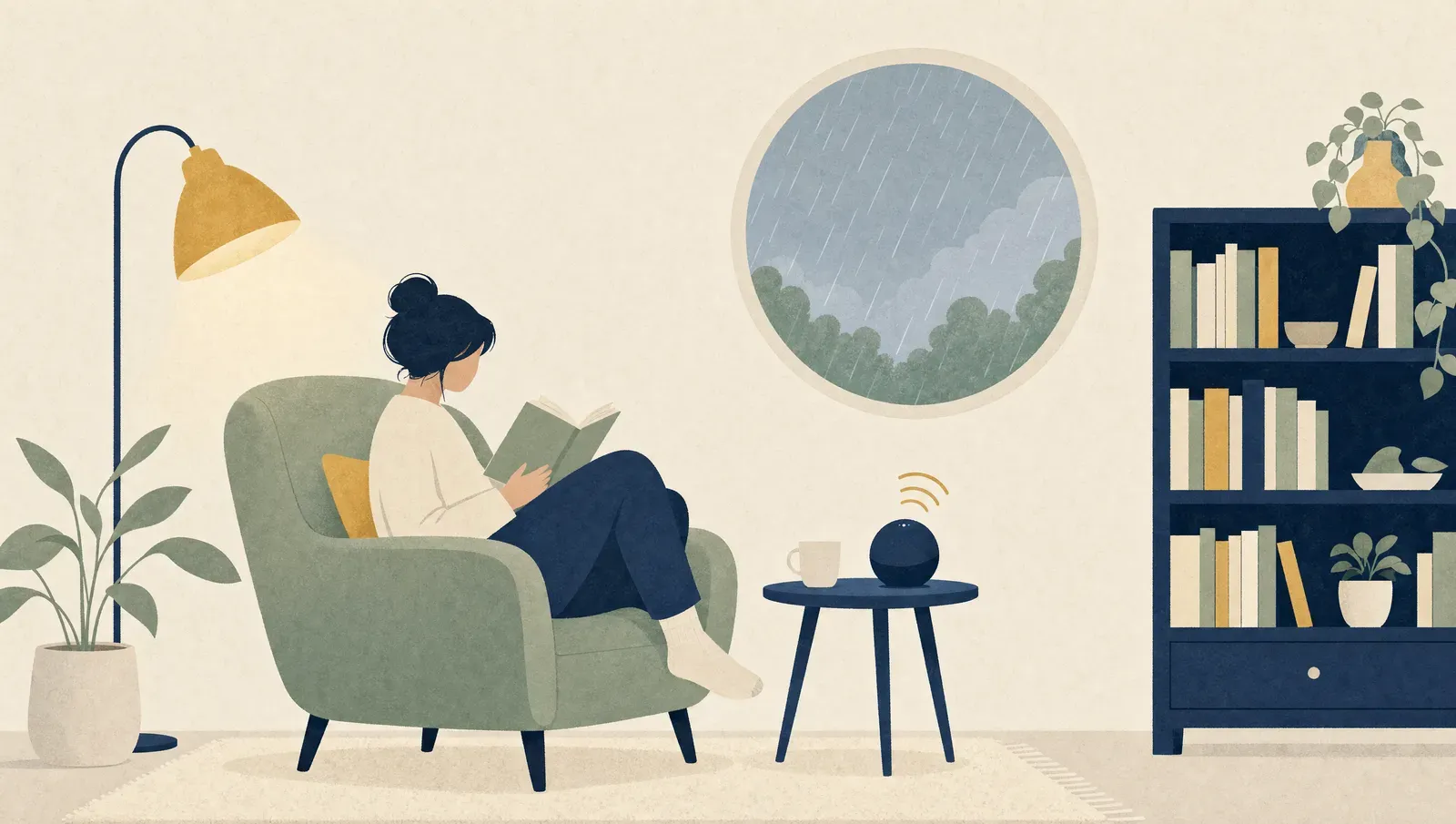
You want atmosphere as much as masking here, and fiction is forgiving. Fireplace crackle, gentle rain, or brown noise all work. Keep it quiet enough that dialogue on the page stays louder in your head than anything in the room.
Go flat and go plain. Brown noise, or pink noise if brown feels close. Nothing with events, nothing with a scene attached, because the material is already asking for everything you have. Silence is a serious option for the hardest pages, and worth testing before you assume sound helps.
Screen reading fragments easily, and most of the interruptions are not acoustic. Pink noise or steady rain give you a continuous signal that the tab switching does not break. Put the phone face down first; a sound layer will not out-compete a notification.
Choose something you can leave running after you put the book down. Gentle rain and brown noise both suit this, on a timer so it does not play all night. If falling asleep is the actual goal, our sleep sound guide covers the choice in more detail.
The problem in both is speech, and the fix is isolation before volume. Well-fitting headphones, then brown or white noise at a level that makes the voices indistinct rather than inaudible. Chasing silence by turning the dial up will tire your ears and you will still hear the loud talker.
Pick one book and two sittings of the same length, same time of day, same chair. Read the first with a sound, the second in silence. Keep everything else identical, including the phone.
Record two numbers each time: pages finished, and how many times you had to re-read a line. Those are the only measures that matter, and they beat how the session felt, because a pleasant session and a productive one are not always the same session. If the sound does not improve either number, it is decoration, which is a perfectly good reason to keep it — just don’t expect more from it.
Set the level once, at the start, at the lowest point where the room recedes. You should still hear a doorbell and anyone speaking to you directly. If your ears feel tired, or you notice ringing or muffled hearing afterwards, you were too loud.
Reading presets
A bright rain blend for readers who find brown noise heavy, a flat studio bed for study reading, and rain over a fireplace for the evening. Start the bright one quiet, and adjust every layer in the browser.
Light, high-frequency texture under rain for a clean reading space.

A low noise floor, spacious focus ambience, and barely audible keys for a settled desk.
Window-side rain and gentle crackle for a quiet evening indoors.
Brown noise first, pink noise if brown sounds too dark. Both put more energy in the low frequencies than white noise, so they sound softer over a long session and carry no words for your reading to trip over. White noise still works when the distraction is sharp, like a keyboard or a voice through a wall. The noise color guide explains what separates them.
For reading and writing, brown noise is the usual starting point, with pink noise as the lighter option and white noise for sharper room noise. Studying covers more than reading, so problem sets and flashcards can take different sounds. Our study sound guide splits it by task, and brown, white and pink noise compared covers the acoustics.
There is no settled answer, and research on noise color and attention is thin and mixed. Try brown or pink noise at a low level and judge it by how many pages you get through. Our brown noise for ADHD guide sets out what the studies do and do not show.
People commonly reach for brown noise or rain because they are steady and have no sudden events in them, which can make a room feel more predictable while you read. This is a description of what people choose, not a treatment. Speak to a clinician about persistent anxiety.
Explore more sounds in Slo
Stack two or three sounds, keep the blend, and let the timer stop it. Slo, on iOS, Android and Mac.